Blog

My-Thesis Partners with the Irish Universities Association
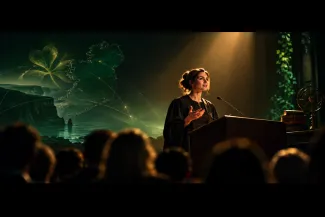
IUA blog image

We are delighted to announce a new partnership between My-Thesis and the Irish Universities Association (IUA), the representative voice of Ireland’s research-intensive public universities.

The IUA represents seven universities — Dublin City University, Maynooth University, Trinity College Dublin, University College Cork, University College Dublin, University of Galway and University of Limerick — and works collectively across higher education policy, research, researcher development, engagement and internationalisation.
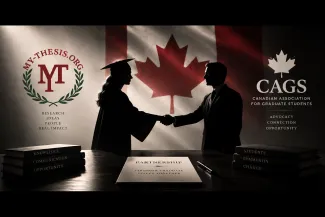
My-Thesis Partners with the Canadian Association for Graduate Studies

Canadian Association for Graduate Studies

We are delighted to announce an official partnership between My-Thesis and the Canadian Association for Graduate Studies (CAGS) — Association canadienne pour les études supérieures.

CAGS is Canada’s national organisation providing leadership, fostering community, and promoting collaboration to advance excellence in graduate education, research, and scholarship. Since its foundation in 1962, CAGS has become a leading voice for graduate education in Canada, bringing together universities and research institutions from across the country.

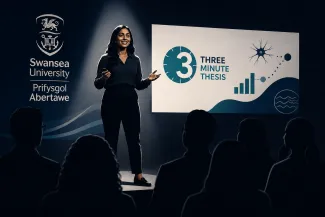
Short Pain, Long Gain: What Do Short Graduate Presentations Do For Confidence and Communication?

Swansea article

One of the reasons for this platform is to not only provide an authentic voice on new cutting-edge research, but also showcase presentation skills which will become a premium in the changing graduate world. But orally presenting your research to an audience is also a valuable learning experience. A new case study from Swansea University suggests that 3MT is more than a public speaking exercise. It can produce measurable changes in how postgraduate researchers understand, present and value their own work.

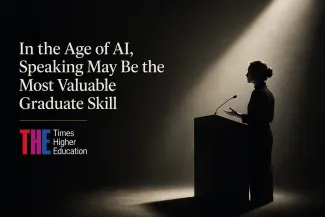
My-Thesis in the Times Higher Education

THE

Artificial intelligence is changing higher education at a remarkable pace.

In a recent opinion piece for Times Higher Education, Bruce Hood argued that as AI becomes increasingly capable of producing polished written work, universities must rethink how they develop and assess one of the most important graduate attributes: the ability to communicate knowledge effectively to other human beings.

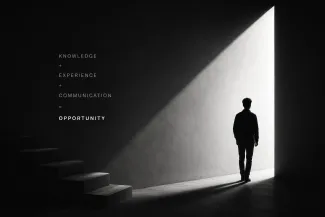
The End of the “Purely Academic” Degree?

Guardian article
Universities are increasingly confronting a difficult reality: a degree alone is no longer enough to guarantee graduate success. The University of Manchester’s proposal to provide work experience opportunities for every undergraduate reflects a wider shift in higher education toward employability, applied learning, and demonstrable skills. This article explores why traditional academic credentials are being supplemented by placements, communication skills, and public-facing portfolios — and why platforms such as my-thesis.org may become increasingly important in helping graduates showcase their expertise in an AI-disrupted labour market.

Why Is Re-Entry So Violent?

Re-entry

For many around the world, the historic voyage of Artemis II around the moon and back again has been a welcomed distraction during these troubling times. 

The spacecraft's re-entry into Earth's atmosphere was not a gentle descent, but something closer to controlled violence. The vehicle streaked across the sky wrapped in a sheath of glowing plasma, briefly resembling a meteor. 

AI Slop is Drowning the Internet

Kurzgesagt
Kurzgesagt is an educational animation organisation founded by Philipp Dettmer in 2013 that produces rigorously researched videos on science, philosophy, politics, and psychology. In a recent video, “AI Slop Is Destroying The Internet,” they warn that the internet is being flooded with low-effort AI-generated content designed to capture attention, leading to what they call a potential “epistemic collapse.” While AI tools can appear highly competent, Kurzgesagt found that although much AI-generated research output seems accurate, a significant portion contains confidently presented fabrications, revealing that such systems optimise for coherence rather than truth. As AI increasingly cites and reinforces other AI-generated material, misinformation risks becoming self-validating, contaminating research, media, and even peer-reviewed literature. Kurzgesagt argue that AI should remain a tool rather than replace human judgment, emphasising the need for rigorous human research and creative integrity—an aim shared by My-thesis in its efforts to protect trustworthy, human-produced academic work from the spread of automated “AI slop.”

The Da Vinci Code: Search for Leonardo da Vinci’s DNA Teaches About Research Innovation

Representation of DNA
The Leonardo da Vinci DNA Project explores how modern scientific methods can address long-standing questions in art history. Its recent report of male human DNA on a red chalk drawing attributed by some to Leonardo demonstrates how non-invasive genetic sampling and collaboration between scientists, conservators, and art historians can produce new forms of evidence, even when attribution remains uncertain. The lack of confirmed DNA from Leonardo himself underscores a key reality of research: progress often comes through incremental insights rather than definitive proof. More broadly, the project reflects a methodological shift with important implications. Genetic traces on artworks may support authentication, reveal how objects were handled over time, and enrich provenance research alongside traditional scholarship. For researchers, particularly those early in their careers, it highlights the value of interdisciplinary approaches, innovation, and working productively with uncertainty.