For many around the world, the historic voyage of Artemis II around the moon and back again has been a welcomed distraction during these troubling times.
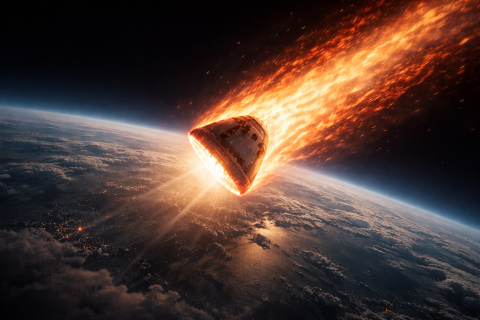
The spacecraft's re-entry into Earth's atmosphere was not a gentle descent, but something closer to controlled violence. The vehicle streaked across the sky wrapped in a sheath of glowing plasma, briefly resembling a meteor.
A spacecraft in orbit is not floating peacefully above the Earth. It is moving sideways at roughly 28,000 kilometres per hour—fast enough that as it falls toward Earth, the surface curves away beneath it. Orbit is continuous falling without landing. That motion carries enormous energy, both from its speed and from its height above the planet. To return home, the spacecraft must lose most of that energy.
Physics, however, is precise about what that means. Energy does not simply disappear. As the spacecraft descends, its energy is transformed. The key mechanism is its interaction with the atmosphere. Colliding with air molecules at hypersonic speed, the vehicle compresses the air in front of it into a shockwave. This compression heats the air to thousands of degrees, turning it into a glowing plasma that surrounds the spacecraft. What we see as fire is really energy being transferred into the surrounding air.
Re-entry, then, is best understood as a process of controlled dissipation. The spacecraft converts ordered motion—its immense speed—into disordered thermal motion in the atmosphere. Most of that energy never enters the vehicle itself. What does reach it is managed by the heat shield, which either absorbs and dissipates heat or, in some designs, gradually burns away to carry heat with it. The challenge is not resisting the energy, but controlling how it flows.
This is why spacecraft do not simply drop straight down. A steep descent would release too much energy too quickly, producing extreme heating and structural stress. Instead, re-entry trajectories are shallow and carefully managed, allowing the spacecraft to shed energy over time rather than all at once.
Seen this way, re-entry illustrates a broader principle that appears across science. Energy is not lost; it changes form. Whether in physics, biology, or learning, the essential process is often not accumulation but conversion—and, sometimes, the careful art of letting things dissipate.
It is gratifying to discover that space research is represented here on my-thesis with graduate talks covering a wide variety of space issues. If you enter “space travel” into the video search, you can view them. It seems likely that with the return to the moon, there will be many more talks from now on given that space travel is back on the agenda.