Image
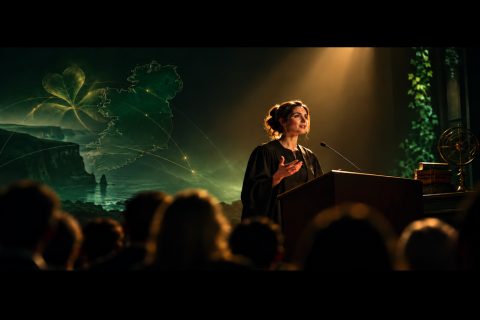
IUA blog image

We are delighted to announce a new partnership between My-Thesis and the Irish Universities Association (IUA), the representative voice of Ireland’s research-intensive public universities.

The IUA represents seven universities — Dublin City University, Maynooth University, Trinity College Dublin, University College Cork, University College Dublin, University of Galway and University of Limerick — and works collectively across higher education policy, research, researcher development, engagement and internationalisation.

Together, these universities educate more than 155,000 students, including almost 10,000 PhD candidates, and account for a substantial proportion of Ireland’s university research activity. In 2024, research investment across IUA universities totalled €670 million.

For My-Thesis, this partnership represents an important opportunity to help make the people behind that research more visible.

Great research deserves to be heard

Universities are exceptionally good at recording written academic achievement. Publications, theses, conference papers and qualifications provide a detailed account of what a researcher has produced.

But they reveal much less about whether somebody can explain their research clearly to another person.

That distinction matters.

Graduate researchers increasingly need to communicate beyond their immediate specialism: to colleagues in other disciplines, industry partners, employers, policymakers, funders and members of the public. The ability to take a complex problem and make it understandable without sacrificing its substance is therefore an important part of becoming an effective researcher.

My-Thesis was created to give that skill greater visibility.

Making spoken communication discoverable

Across Ireland, graduate researchers already give excellent presentations through doctoral showcases, conferences, public-engagement events and competitions such as the Three Minute Thesis.

Too often, however, these presentations are transient. A researcher may spend weeks preparing an outstanding explanation of their work, deliver it once, and then see the recording disappear into a university website, video channel or archive where it becomes difficult to find.

My-Thesis provides a different model.

We catalogue graduate research presentations and make them searchable by researcher, institution, subject and topic. This means that an individual presentation can continue to work for the researcher long after the original event has finished.

It becomes part of a visible research profile rather than simply a recording of a past occasion.

Connecting research with opportunity

This matters not only for academic visibility but also for researcher development.

The IUA describes its universities as institutions that nurture talent and create, disseminate and apply knowledge while building partnerships across society and internationally. My-Thesis complements that ambition by providing another route through which the expertise of graduate researchers can be discovered.

A prospective collaborator might find someone working on a related research problem. An employer might encounter a doctoral researcher with precisely the specialist knowledge they need. A journalist or policymaker might discover someone capable of explaining an emerging field. Another student might simply find an inspiring example of what research in that discipline looks like.

In each case, the presentation provides something that a conventional academic profile cannot: the opportunity to hear the researcher explain their own work in their own voice.

Communication as part of researcher development

The partnership also reflects a wider change in how we think about doctoral education.

A PhD develops deep subject expertise, but relatively few doctoral graduates will spend their entire careers communicating solely with specialists in their own discipline. Researchers increasingly operate across disciplinary, professional and organisational boundaries.

Being able to communicate clearly is therefore not separate from research excellence. It is one of the ways research achieves impact.

This is particularly relevant as universities place greater emphasis on transferable skills, researcher careers, public engagement and collaboration beyond academia.

My-Thesis provides a simple way of making one of those capabilities visible and verifiable.

Showcasing Irish graduate research

Our partnership with the Irish Universities Association will help us highlight the extraordinary breadth of research being undertaken by graduate researchers across Ireland.

The IUA already brings together senior leaders in graduate studies and research from across its member universities, creating a strong national network for sharing practice and developing graduate education.

We hope My-Thesis can add another dimension to that work: a shared public space where graduate researchers can showcase not only what they are studying, but also how well they can communicate it.

Over time, our ambition is straightforward.

Every graduate researcher should have the opportunity to produce a concise, accessible explanation of their work — and to have that communication recognised as part of their professional identity.

The partnership with the Irish Universities Association brings us another important step closer to that goal.

We look forward to working with the IUA and its member universities to make Ireland’s graduate research — and the remarkable people carrying it out — more visible to the world.
Image
Canadian Association for Graduate Studies

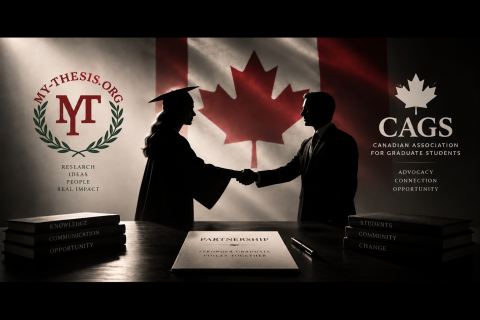
We are delighted to announce an official partnership between My-Thesis and the Canadian Association for Graduate Studies (CAGS) — Association canadienne pour les études supérieures.

CAGS is Canada’s national organisation providing leadership, fostering community, and promoting collaboration to advance excellence in graduate education, research, and scholarship. Since its foundation in 1962, CAGS has become a leading voice for graduate education in Canada, bringing together universities and research institutions from across the country.

Its mission strongly complements that of My-Thesis. CAGS supports the development of individuals who, through scholarship, research and innovation, contribute to the flourishing of societies in Canada and internationally. Increasingly, that means not only producing excellent research, but also being able to explain why that research matters.

Research needs to be communicated

Graduate researchers develop extraordinary depth of expertise. Yet the ability to communicate that expertise clearly to people outside a highly specialised field is a different skill — and one that is increasingly important both within and beyond academia.

Researchers must be able to explain complex ideas to colleagues, funders, employers, policymakers, industry partners and the wider public. Spoken communication therefore deserves to be recognised as an important part of graduate education rather than simply an optional extra.

This is one of the reasons competitions such as the Three Minute Thesis (3MT®) have become so successful. Asking researchers to explain years of work in just three minutes requires clarity, confidence and a deep understanding of what is genuinely important about their research.

Many CAGS member institutions participate in 3MT and related research communication initiatives, producing thousands of compelling presentations by graduate researchers across an extraordinary range of disciplines.

Giving graduate research a longer life

One of the challenges with research presentation competitions is that excellent talks can quickly disappear from view after the event itself.

My-Thesis was created to change that.

By cataloguing research presentations and making them searchable by researcher, institution, discipline and topic, My-Thesis gives these presentations a life beyond the competition or event at which they were originally delivered.

A three-minute presentation can become more than a moment on a stage. It can become part of a researcher’s professional profile: something that can be discovered by potential collaborators, employers, students and other researchers.

For universities, this also creates an opportunity to showcase the breadth of graduate research taking place across their institution.

Showcasing Canadian graduate researchers

Through our partnership with CAGS, we look forward to showcasing presentations from graduate researchers across Canada and helping make their work more discoverable internationally.

CAGS represents around 69 universities and research institutions, creating an exceptional community of graduate education, scholarship and innovation.

Many of these institutions already place considerable emphasis on research communication. Our aim is to complement that work by providing a platform through which students can demonstrate those skills publicly and retain a lasting record of what they have achieved.

Over time, we hope that participation will extend well beyond competition finalists. Our broader ambition is that every graduate researcher should have the opportunity to demonstrate their ability to communicate their research clearly and engagingly.

From research output to researcher profile

Academic careers have traditionally been documented primarily through written outputs: publications, theses, conference abstracts and CVs. These remain essential, but they capture only part of what a researcher can do.

The ability to stand in front of an audience and explain a difficult idea clearly is also an important scholarly and professional skill.

My-Thesis profiles are designed to make that capability visible.

A searchable presentation allows someone encountering a researcher for the first time to hear them explain their own work, in their own words. In just a few minutes, it can communicate expertise, enthusiasm, clarity and confidence in ways that are difficult to capture on a conventional CV.

For students moving into careers outside academia, where the ability to communicate complex information to non-specialists is frequently essential, this may be particularly valuable.

A shared commitment to graduate education

The partnership between CAGS and My-Thesis reflects a shared belief that graduate education should prepare researchers not only to generate knowledge, but also to communicate it.

We are enormously pleased to be working with CAGS and its member institutions, and we look forward to highlighting the extraordinary diversity of graduate research taking place across Canada.

Most importantly, we hope the partnership will help create more opportunities for graduate researchers to be seen, be heard and be discovered.

To find out more about the Canadian Association for Graduate Studies, visit CAGS.ca.


Image
THE

Artificial intelligence is changing higher education at a remarkable pace.

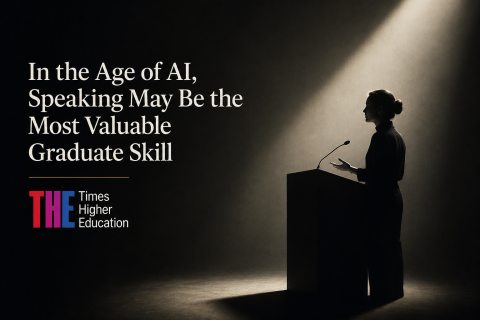
In a recent opinion piece for Times Higher Education, Bruce Hood argued that as AI becomes increasingly capable of producing polished written work, universities must rethink how they develop and assess one of the most important graduate attributes: the ability to communicate knowledge effectively to other human beings.

For decades, universities have focused primarily on written communication. Essays, reports, dissertations and examinations have been the traditional ways students demonstrate understanding. But the emergence of generative AI raises an uncomfortable question: if a machine can help produce convincing written work, how can employers, educators and society distinguish between possessing knowledge and simply presenting it?

The answer may lie in a skill that has often been overlooked within higher education: spoken communication.

Communication Beyond Writing

The ability to explain complex ideas clearly has always mattered. Whether presenting research, pitching a business proposal, explaining technical concepts to clients, or leading a team, professional success often depends on communicating knowledge effectively.

Employers recognise this. Across multiple surveys, verbal communication consistently ranks among the most sought-after graduate attributes. Yet many students complete their degrees having received relatively little formal training in public speaking, audience engagement or persuasive communication.

This is particularly surprising given that communication is not simply the transmission of information. Effective speakers must think on their feet, respond to questions, establish credibility, build trust and adapt to their audience in real time. These are deeply human skills that AI cannot easily replicate.

Knowledge Is Not Enough

Good communication begins with understanding.

One concern is that AI may allow students to engage less deeply with the material they are studying. If students rely on AI to generate essays and reports, they may miss the intellectual struggle that often produces genuine comprehension.

But even deep knowledge is not sufficient on its own.

Many graduates possess considerable expertise but struggle to explain it to non-specialists. Anyone who has attended an academic conference knows that expertise and communication ability do not always go hand in hand.

Communication is a skill that requires practice, feedback and repetition. Like any complex ability, it improves through deliberate effort.

Why Three Minute Thesis Matters

This is one reason the Three Minute Thesis (3MT®) competition has become such a global success.

Developed by the University of Queensland and now adopted by more than a thousand institutions worldwide, 3MT challenges doctoral researchers to explain years of work in just three minutes using language that a general audience can understand.

The challenge is deceptively difficult.

Researchers must identify the core message of their work, strip away unnecessary jargon, construct a compelling narrative and connect with an audience that may know nothing about their field.

In doing so, they develop precisely the communication skills that employers, policymakers, journalists and the public increasingly value.

The Problem of Visibility

Yet there is another challenge.

Every year, thousands of students participate in competitions, public engagement events, conference presentations and research showcases. These experiences develop valuable communication skills, but the evidence often disappears once the event concludes.

A presentation may be uploaded to YouTube, buried within a university playlist, and never seen again.

The achievement itself becomes difficult to discover, verify or showcase.

Why My-Thesis?

My-Thesis was created to address this problem.

The platform provides a searchable index of research presentations, enabling graduate researchers to make their talks more discoverable and giving audiences a way to find research by topic, institution, researcher or keyword.

But the platform is about more than research visibility.

At its core, My-Thesis recognises communication as an academic achievement in its own right.

A successful presentation demonstrates not only what a researcher knows but also their ability to explain, persuade and engage. These are increasingly important skills in a world where information is abundant but understanding remains scarce.

Looking Forward

Artificial intelligence is undoubtedly transforming education. Universities will continue to debate how best to assess knowledge and maintain academic integrity in an age of AI-assisted learning.

However, one consequence seems increasingly clear.

The graduates who thrive will not simply be those who possess knowledge. They will be those who can communicate it effectively, authentically and persuasively.

The ability to stand in front of an audience and explain an idea clearly may become one of the most valuable skills a graduate can possess.

And that is precisely why platforms such as My-Thesis matter more than ever.

Image
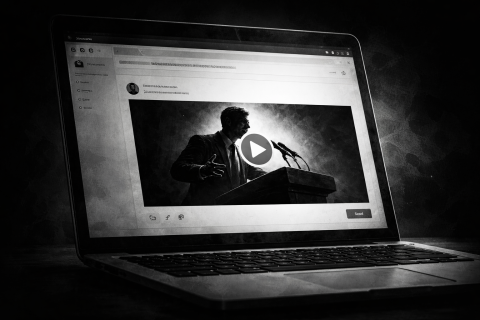
image of vido on laptop

Academic inboxes are crowded. Between calls for papers, administrative messages, newsletters, and teaching communications, even genuinely important emails are easy to overlook. For researchers trying to share their work—whether with supervisors, collaborators, institutions, or external partners—standing out is increasingly difficult.

One simple strategy consistently cuts through the noise: video.

Short, well-crafted video messages can dramatically increase engagement, clarity, and response rates. For platforms like my-thesis.org, which focus on authentic spoken research communication, video emails are not marketing gimmicks—they are an extension of how scholars already explain, defend, and share ideas.

Below we outline why video works in academic contexts and how researchers can use video email effectively, without turning scholarship into sales.

1. Video increases engagement and response: Market research consistently shows that emails containing video outperform text-only messages in both open and click-through rates. This matters for researchers when:

  • Requesting feedback on work
  • Introducing themselves to potential collaborators
  • Sharing research outputs beyond journals
  • Contacting institutions, funders, or industry partners

Video reduces the cognitive effort required to understand complex ideas and increases the likelihood that recipients will actually engage.

2. Video makes research more memorable: We are far more likely to remember visual explanations than dense text. Spoken explanations allow researchers to:

  • Emphasise the why behind their work
  • Use analogy and narrative
  • Signal confidence and credibility

This is precisely why formats such as the 3-Minute Thesis work so well—and why short video emails can act as a gateway to deeper engagement with research.

3. Video humanises expertise: Academic emails often sound interchangeable. Video reintroduces:

  • Voice
  • Expression
  • Presence

This is particularly valuable for early-career researchers, where trust and visibility matter. A short video allows recipients to see who is behind the research, not just the project title or affiliation.

4. Video can save time—for everyone: Long explanatory emails are inefficient. A 30–60 second video can replace several paragraphs of clarification, reduce back-and-forth, and prevent misunderstandings—especially when explaining:

  • Methods
  • Concepts outside one’s discipline
  • The motivation behind a project

Where video emails work especially well in academia

Researchers commonly use video emails to:

  • Introduce themselves to potential supervisors or collaborators
  • Share a recorded 3-Minute Thesis or public talk
  • Explain a grant idea or project overview
  • Support teaching and supervision communication
  • Promote public engagement or impact activities

Platforms like my-thesis.org extend this further by linking short talks to verified researchers and institutions, allowing video communication to remain credible, contextualised, and discoverable.

Final thought

Email is not disappearing—academic inboxes will only get busier. As research becomes more interdisciplinary and public-facing, spoken explanation is becoming a core scholarly skill, not an optional extra.

Short video emails are not about self-promotion. They are about clarity, accessibility, and human connection—all of which sit at the heart of good research communication.

For researchers who already know how to explain their work aloud, video is simply the most direct way to let others hear it.