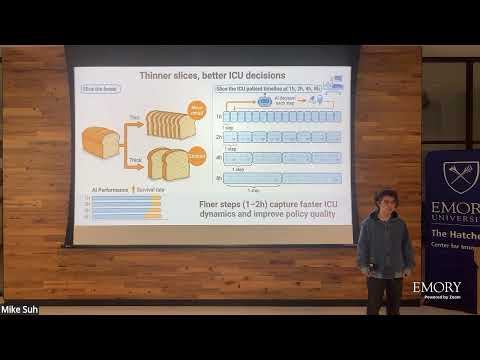
This research investigates how the choice of time interval affects reinforcement learning models for sepsis treatment in intensive care. By comparing one-, two-, four-, and eight-hour patient timelines, it demonstrates that shorter intervals better capture patient dynamics, improve estimated survival outcomes, and may enable more effective AI-assisted clinical decision-making.

2026
This research explores how heterogeneous AI agents can establish common ground during collaboration. By separating communication and action into distinct decision-making policies, agents can engage in micro-conversations that create shared understanding. The work aims to improve teamwork among diverse robots and support future human-AI collaboration in complex environments.

2025
This research develops explainable AI systems to detect early signals of ideological extremism and potential violence in online communications. By integrating social science and machine learning, the project produces interpretable threat assessments for prevention efforts. The framework also extends to healthcare, including rare disease detection using explainable AI models.

Traditional neural networks are powerful but difficult to interpret and vulnerable to small input changes. This research develops wavelet-based neural networks with provable stability guarantees, extending the scattering transform to texture modeling. The approach reduces feature complexity while improving interpretability, enabling more reliable and mathematically explainable AI systems.

2025
This research explores next-generation digital twins—virtual representations of real-world systems that support decision-making through simulation and AI. By combining decentralization, privacy-preserving architectures, explainable AI, and scenario analysis, the work aims to help individuals and organizations evaluate alternative futures, make informed decisions, and build more transparent intelligent systems.

2025
This research develops human–AI methods to prioritize massive data streams, especially in public health. By combining expert expectations with extreme value theory, it ranks events by contextual importance, reducing alert overload. Deployed nationally, the approach triaged thousands of outbreaks and data-quality issues, making big data interpretable, actionable, and life-saving decisions.