
This research investigates whether Alexa can support speech practice for people with Parkinson’s disease. After eight weeks of home use, nine of ten participants developed stronger voices. Although not a replacement for professional speech therapy, voice assistants could provide accessible, everyday opportunities to practise louder, clearer speech outside clinical settings.

2026
This talk explores red light laser therapy as an accessible recovery approach for minor brain injury. Using a portable device applied to eight head areas, the research tracks fatigue, pain, attention, memory, brain activity and saliva markers. Early participants showed improved symptoms, suggesting promise for practical, inclusive brain health support.

This research redefines digital health literacy for an AI-driven world, emphasizing the alignment between users and technology. Using a Delphi method, it identifies three core components—knowledge, skills, and context. The resulting framework guides the design of digital health tools that better support behavior change by adapting to users’ real-world needs.
2015
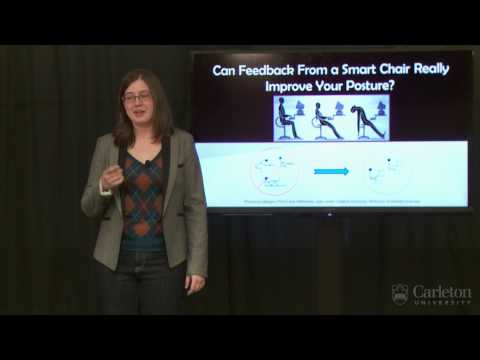
This research investigates smart office chairs that monitor posture and provide real-time feedback to reduce pain and improve ergonomics. By comparing different feedback methods, the study evaluates whether timely reminders can effectively change behavior. The goal is to enhance workplace health while maintaining productivity in increasingly sedentary environments.

This research addresses excessive false alarms in hospital medical devices, which burden staff and distress patients. By detecting and filtering noisy data, the proposed system prevents false alerts while preserving true ones. Early results show complete removal of false alarms, improving efficiency, patient experience, and clinical response in healthcare settings.

This research highlights the limitations of current food safety detection and introduces nanoparticle-based smart packaging. These nanosensors detect gases from spoilage and signal safety through colour changes. By replacing guesswork with real-time indicators, this approach could prevent foodborne illness, improve consumer confidence, and modernise food safety in an increasingly technological world.

2026
This research shows that pulse oximeters are less accurate for darker skin tones due to biased design. By developing sensors that account for skin pigmentation, accuracy improves significantly across populations. The work highlights the need to embed equity into medical device design to ensure fair and reliable healthcare for all.

This research develops a spatial “GPS” for lung cancer screening by mapping CT scans into a shared coordinate system. By identifying high-risk regions for malignant nodules, it supports radiologists and AI in improving diagnostic accuracy, decision-making, and interpretability, transforming screening from broad search to targeted, data-driven precision.

This research presents a new fractional mathematical model for cardiovascular dynamics that maintains the accuracy of traditional methods while greatly reducing complexity. Using only five interpretable parameters instead of twenty, the model analyzes blood pressure in the frequency domain, providing clearer insight into heart function and offering potential improvements for diagnosis and treatment.

2025
This research examines how AI is used in NHS radiology and challenges claims that it will replace radiologists. Instead of full automation, AI supports clinicians, helping manage workforce shortages while radiologists retain responsibility for diagnosis and treatment decisions. Evidence, not hype, should guide debates about AI and work.