
This research investigates the role of force feedback in virtual reality training. By comparing users with and without haptic feedback, it examines effects on brain activity, skill acquisition, and real-world performance. The study aims to improve VR training systems by incorporating sensory input essential for effective motor learning and skill transfer.
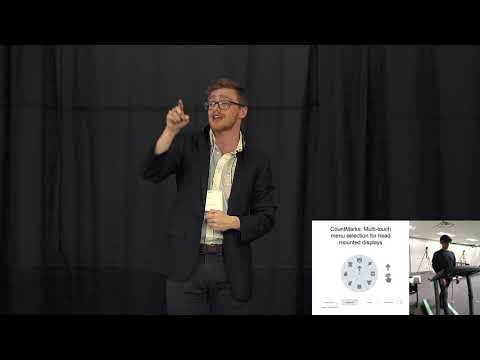
This research introduces “Countmarks,” an ergonomic interaction method for smart glasses using multi-finger gestures on a smartphone. It offers a faster, more accurate, and private alternative to controllers, voice commands, and mid-air gestures. The system improves usability, accessibility, and safety, particularly in real-world contexts like walking or driving.
This research develops context-aware AI integrated with extended reality glasses, enabling systems to perceive and interact within real-world environments. Applications include language learning and memory support. Findings show such AI fosters more natural, collaborative interactions, enhancing human perception, memory, and decision-making beyond traditional screen-based interfaces.