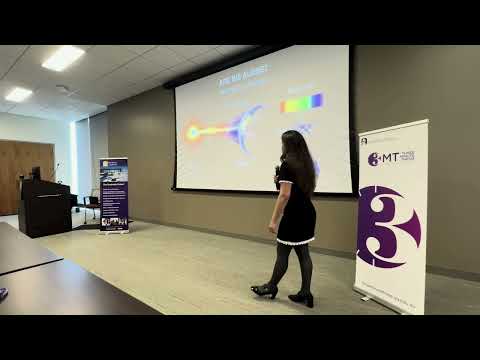
This research uses artificial intelligence and machine learning to analyze light from distant exoplanets. By interpreting atmospheric spectral signatures, it aims to identify potentially habitable worlds and search for signs of life beyond Earth. The work supports future space missions designed to answer one of humanity’s oldest questions: Are we alone?

This research uses artificial intelligence and astronomical data to search for signs of extraterrestrial intelligence. By applying anomaly-detection techniques to telescope images, the project identifies unusual signals or patterns that may indicate intelligent activity, with the ultimate goal of detecting and decoding potential messages from civilizations beyond Earth.

2026
This research examines a rare Martian meteorite containing garnet, a mineral that records geological conditions. Using laser mass spectrometry and microscopy, it investigates how these garnets formed despite Mars lacking plate tectonics. The findings offer insights into planetary evolution and improve understanding of Martian geology and future exploration targets.

Directly imaging Earth-like exoplanets is one of astronomy’s greatest challenges. Using GLINT, an interferometric instrument on the Subaru Telescope, this research cancels overwhelming starlight to reveal faint nearby planets—paving the way toward discovering another “pale blue dot” and possibly a second Earth.

The researcher studies how clouds on distant exoplanets affect their climates and potential for life. Working with NASA, they model how exotic materials—like iron or sapphire clouds—absorb and reflect light. They found particle shape greatly influences temperature and habitability, helping determine whether alien worlds could support liquid water and life.