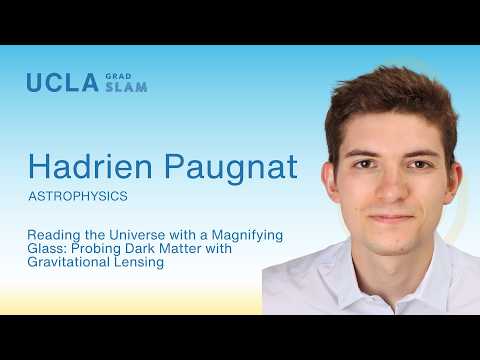
Dark matter makes up most of the universe but cannot be directly observed. This research studies how dark matter halos evolve using cosmological simulations and the principle of maximum entropy. Results show halo entropy increases over time, indicating their evolution toward equilibrium follows fundamental thermodynamic principles.


Only five percent of the universe is visible through light, leaving most of it unexplained. Gravitational waves provide a new way to explore this hidden cosmos. By detecting these signals early, researchers can predict cosmic collisions and coordinate telescopes in advance, enabling simultaneous observations that deepen our understanding of the universe.

This talk explains the challenge of detecting Earth-like exoplanets, the noise caused by stellar activity, and how a solar calibration instrument helps disentangle star signals from planetary ones. The speaker also studies extreme exoplanet systems, revealing surprising orbital alignments that challenge theories of giant-planet migration and highlight how much we still don’t understand.


This project develops a 200-metre space reflector antenna using a modular “LEGO-like” assembly system. Designed for compact launch and robotic construction, it enables stronger, higher-quality interstellar communication. The work also models structural behaviour during assembly and could support building other large space structures, advancing deep-space exploration.

This research uncovers 400 “zombie stars”—dead white dwarfs revived through collisions with companion stars. Their dramatic brightness changes allow astronomers to detect them and use them as probes into the galaxy’s ancient history and future evolution. These rare reanimated stars offer a powerful new tool for understanding the Milky Way.

My talk explains how neutron stars—extremely dense remnants of stellar explosions—contain matter we cannot study on Earth. By analyzing gravitational waves from colliding neutron stars, the speaker models how their deformation (or “squishiness”) reveals their internal composition. This method may uncover entirely new forms of matter and transform fundamental physics.

The researcher studies how clouds on distant exoplanets affect their climates and potential for life. Working with NASA, they model how exotic materials—like iron or sapphire clouds—absorb and reflect light. They found particle shape greatly influences temperature and habitability, helping determine whether alien worlds could support liquid water and life.