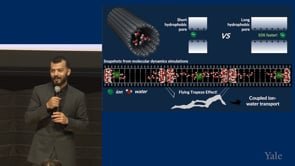
This research uses molecular simulations to study how ions and water move through nanopores, revealing counterintuitive effects of pore length and ion–water coupling. Understanding these nanoscale transport mechanisms helps improve desalination membrane design and provides insight into highly efficient biological channels such as aquaporins.

This research uses atomic-scale computer simulations to design safer, more efficient battery electrolytes. By modelling ion movement like a “river” inside a battery, the project identifies top-performing materials before laboratory testing. The goal is to create faster-charging, higher-capacity, non-toxic batteries that support global renewable-energy transitions and a net-zero future.