This research uses LiDAR and individual tree segmentation to replace traditional polygon-based forest inventories with precise, tree-level data. By modelling the growth and interactions of individual trees, it enables more accurate forest management, improving timber planning, ecosystem resilience, and climate adaptation while supporting sustainable forestry across British Columbia.
This research investigates genetic resistance in pine trees that survive mountain pine beetle attacks. By identifying protective genes and testing them in fast-growing model plants, it reveals how trees defend themselves. The findings support breeding more resilient forests, helping address large-scale ecological damage and ensuring the future sustainability of Western Canada’s forests.
Pakistan is highly vulnerable to climate change due to low forest cover, rising temperatures, glacier melting, floods, droughts, and agricultural decline. With only 4.2 million hectares of forest, impacts are severe. Government initiatives like the 10 Billion Tree Tsunami and mangrove restoration aim to improve resilience and environmental sustainability.
This study evaluated a PointNet++ deep learning model for binary classification of Pinus sylvestris and Quercus pyrenaica using only LiDAR 3D point clouds. A balanced dataset of 160 trees achieved 91% accuracy, showing that geometric features alone can effectively discriminate species, highlighting the potential of lightweight AI models for forest inventories.
This research develops new height–diameter models for key Spanish tree species to improve forest management planning. While initial models fit data visually, statistical performance remains weaker than current equations. Future work will incorporate stand-level variables such as basal area and dominant height to enhance accuracy and reduce estimation errors.

Bur Oak Blight threatens Iowa’s most iconic tree. Current detection is slow and often too late. This research uses leaf-level reflectance and satellite imagery to identify early, invisible signs of infection across millions of trees. The approach enables rapid mapping of blight severity and helps protect Iowa’s ecological and cultural heritage.
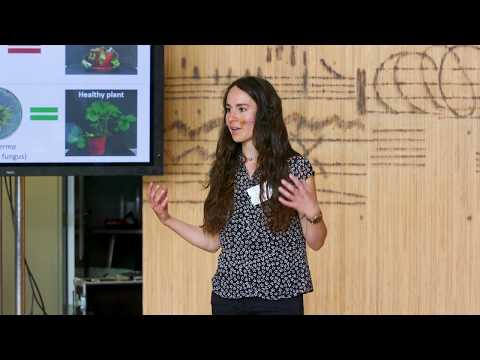
This research investigates Trichoderma fungi as a biological control against Armillaria honey fungus, a major plant pathogen with no effective treatment. Forty Trichoderma strains were tested; seven reduced disease in plants and one prevented infection entirely. These findings suggest plants could be inoculated like a “vaccination” to protect forests, crops, and gardens.