This research investigates how wind transports sand across Mars to improve the safety of future space missions. Combining measurements from Earth-based analogue dunes with computational modelling and NASA satellite data, the approach predicts Martian winds and sandstorms with high accuracy, potentially reducing landing risks and supporting future human exploration of Mars.
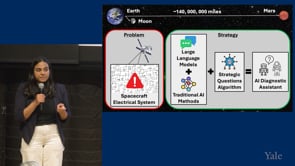
This research develops an onboard AI diagnostic assistant for space missions that can independently investigate life-critical anomalies. By learning how humans ask strategic diagnostic questions, the system combines language models and traditional AI to actively reason through unprecedented spacecraft failures when communication with Earth is delayed.