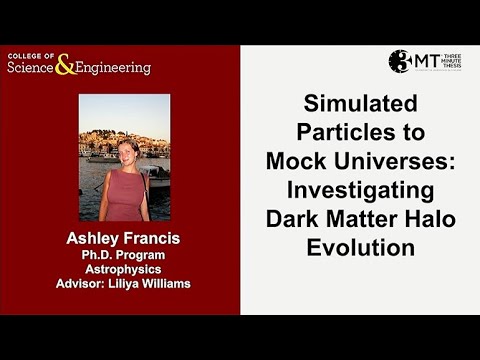
Dark matter makes up most of the universe but cannot be directly observed. This research studies how dark matter halos evolve using cosmological simulations and the principle of maximum entropy. Results show halo entropy increases over time, indicating their evolution toward equilibrium follows fundamental thermodynamic principles.


This research develops a theoretical framework for understanding electron–hole interactions in quantum dots, focusing on positive and negative trions. By analytically modeling their behavior under electric and magnetic fields, it bridges gaps between theory and experiment, supporting advances in quantum electronics, energy technologies, and targeted medical applications.

This research examines unexpected beauty-quark decay patterns observed at LHCb that violate Standard Model predictions. The anomalies suggest a new force and a hypothetical leptoquark particle that couples mainly to third-generation matter. By modelling these effects, the work guides experimental searches and may shed light on the long-standing mystery of particle-generation hierarchies.