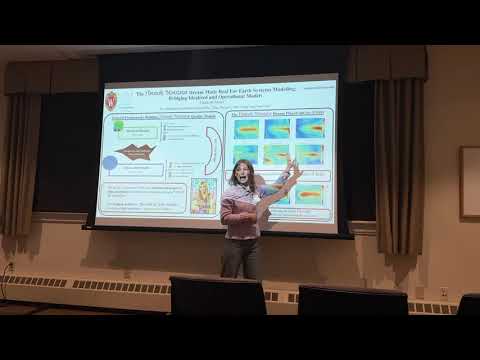
This research develops a machine-learning and data-assimilation framework that combines idealized and operational Earth systems models into a high-resolution, physically realistic “bridging model.” Applied to the El Niño–Southern Oscillation, the approach improves climate simulation accuracy while enabling exploration of alternative climate regimes and physically consistent what-if scenarios.
2025
This research develops rigorous mathematical foundations for consensus-based optimization algorithms, where large groups of interacting particles collaboratively search for optimal solutions. Using mean-field theory and propagation of chaos, the work proves long-term stability and improves optimization methods for applications including robotics, aircraft design, and drug discovery under real-world constraints.