This research investigates why children struggle to learn pronouns and why these difficulties vary across languages. Through cross-linguistic experiments and eye-tracking, it shows that pronouns pose an intrinsic processing challenge. Some languages compensate for this difficulty, offering new insights into language development and human learning.
The speaker shows that using simple hand gestures helps students make abstract fraction concepts concrete. After analyzing fourth and fifth graders’ problem-solving, they found that gestures representing fraction size predicted higher performance. Gesture-based instruction is free, equitable, and effective across demographic groups, offering a powerful tool to improve math learning.
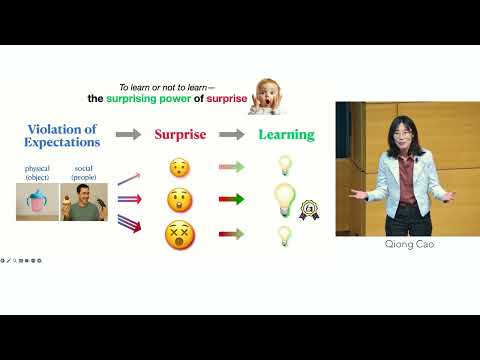
Babies are exceptional learners, possibly because they use surprise to guide attention and learning. My research shows that infants learn more after surprising physical or social events. Adults show a Goldilocks effect—optimal learning from moderate surprise. Understanding surprise-based learning in babies may help improve future artificial intelligence systems.
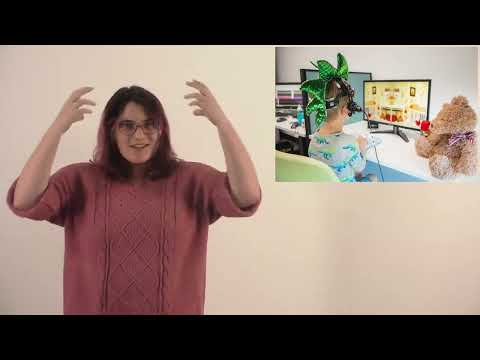
This research investigates how children use the left and right hemispheres for language and spatial reasoning. Using ultrasound while children play custom games, it shows that those with the typical left-language/right-spatial pattern tend to have stronger skills. The findings reveal how brain-activity patterns relate to developmental risks and complex tasks like reading.