
My thesis uncovers the forgotten history of the US Children’s Bureau, once a global leader in children’s rights. Through archival research, it traces postwar innovation, a 1960s expansion inspired by civil rights, and the bureau’s dismantling under Nixon. The work highlights today’s parallels and the need to restore moral leadership for children.
The speaker develops RADARS, a programmable RNA-guided gene-delivery system that activates only in cells with specific RNA “fingerprints.” Their thesis tackles weak activation when target RNA is rare, creating new mechanisms to bind targets more tightly. These innovations aim to enable safer, cell-specific cancer therapies through precise molecular control.
The speaker revisits the 1912 Marconi insider-trading scandal, showing how unfounded allegations spread through fringe media triggered national uproar and revealed elite anxieties about power, technology, and public discourse. Their archival research argues that the real scandal was elites losing control of information—an issue echoed today in social media, misinformation, and democratic instability.
2022
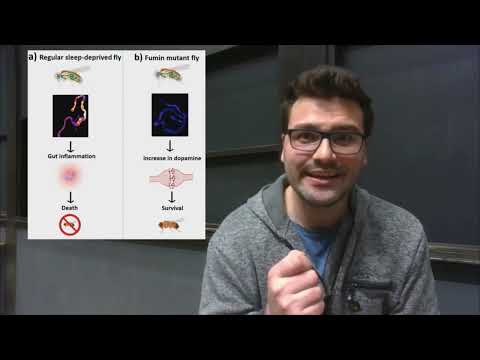
Fruit flies normally die from sleep loss due to lethal gut inflammation. But a mutant “fumin” fly, which sleeps very little, survives without inflammation. This research investigates how altered dopamine processing protects these flies, offering insight into why sleep is essential and how sleep loss contributes to disease.