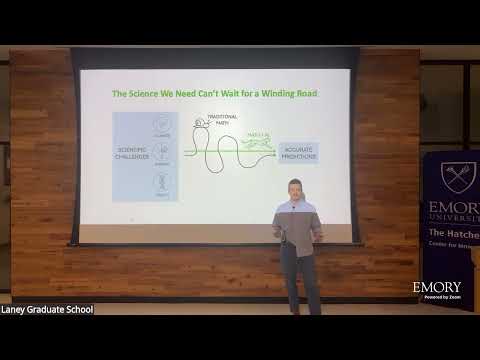
This research uses artificial intelligence to accelerate scientific simulations by learning patterns from traditional mathematical models. Rather than replacing physics, the AI predicts efficient starting points for complex calculations, producing accurate results much faster. The approach could dramatically speed up research in fields such as medicine, engineering, and climate science.
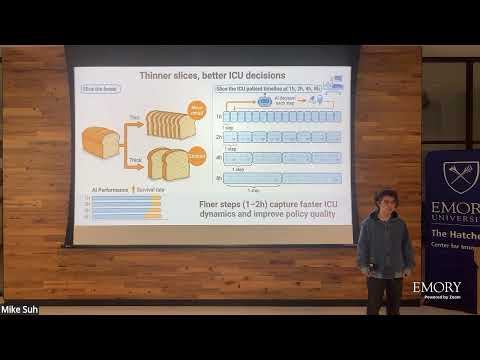
This research investigates how the choice of time interval affects reinforcement learning models for sepsis treatment in intensive care. By comparing one-, two-, four-, and eight-hour patient timelines, it demonstrates that shorter intervals better capture patient dynamics, improve estimated survival outcomes, and may enable more effective AI-assisted clinical decision-making.
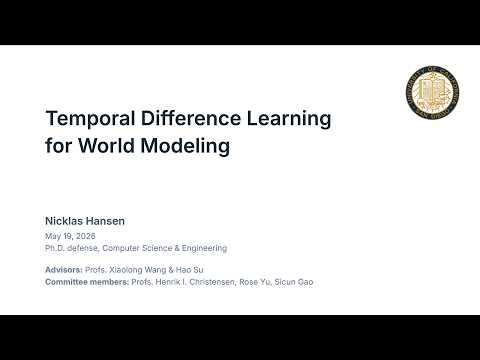
This dissertation presents temporal-difference learning methods for building world models that enable intelligent agents and robots to predict, plan and act. It introduces TD-MPC, which learns compact latent dynamics, rewards and value estimates for model-predictive control, and TD-MPC2, a more robust successor requiring little task-specific tuning. Experiments demonstrate faster real-world robot learning, scalable multitask performance and a unified model spanning 200 tasks across ten domains. The research also examines interactive generative world models and their tendency to hallucinate physically implausible futures. Targeted data collection in uncertain regions substantially reduces these errors, suggesting routes toward safer, uncertainty-aware autonomous systems and robotics.

2026
This research develops a fast algorithm to identify rare gravitational lenses in images from the Euclid Space Telescope. By analysing how galaxies bend light, it maps the distribution of invisible dark matter, helping astronomers investigate one of the greatest mysteries in physics: the nature and composition of dark matter.
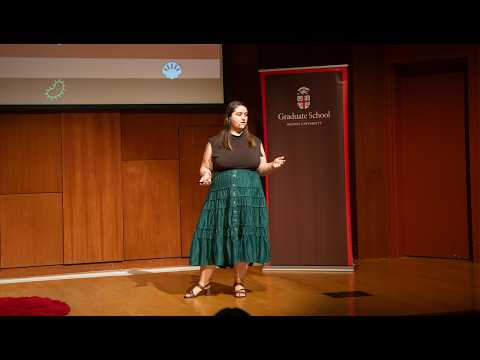
This research investigates how coccolithophores—microscopic marine algae that both absorb and release carbon dioxide—have influenced Earth's carbon cycle over the past three million years. Using fossil sediments, geochemistry, and machine learning, it reconstructs past ocean ecosystems to improve predictions of how marine carbon cycling will respond to future climate change.

2025
This research develops Roblonski, a compact robotic platform that automates photoredox chemistry using microscopic droplets and visible light. By reducing chemical use, waste, and manual effort by over 90%, it generates high-quality data for AI-driven discovery, paving the way for faster, greener, and more intelligent self-driving chemistry laboratories.
This research improves flood prediction by analysing data from more than 3,000 rivers worldwide and using local fitting techniques to compare similar weather events. By relying on relevant historical data rather than human intuition, the model aims to produce more accurate flood forecasts and strengthen disaster preparedness under climate change.
This research investigates how emotions contribute to financial panic using controlled laboratory stock market experiments. By combining sentiment analysis, facial expression recognition, and personality profiling, it aims to identify the emotional drivers of irrational selling behaviour and provide evidence for policies that promote greater financial market stability.
This research teaches AI to understand and generate the sense of touch by combining visual information with high-resolution tactile data. The technology enables realistic digital textures, improves online shopping, enhances virtual experiences, and creates accessible tactile graphics for blind and low-vision users, making AI more inclusive and human-centred.
This research develops scalable motion-planning algorithms that enable large teams of robots to work together safely and efficiently. By combining machine learning with search algorithms, the work delivers both speed and reliability, supporting applications from automated warehouses to disaster response, infrastructure repair, and future space exploration.