This research highlights the limitations of current food safety detection and introduces nanoparticle-based smart packaging. These nanosensors detect gases from spoilage and signal safety through colour changes. By replacing guesswork with real-time indicators, this approach could prevent foodborne illness, improve consumer confidence, and modernise food safety in an increasingly technological world.
This research develops an electrochemical sensor to continuously monitor stress by detecting cortisol, a key stress hormone. Using DNA aptamers and nanostructured electrodes, the sensor overcomes traditional detection limits, improving signal strength and durability. The technology offers a noninvasive method for long-term stress tracking to support prevention and treatment.
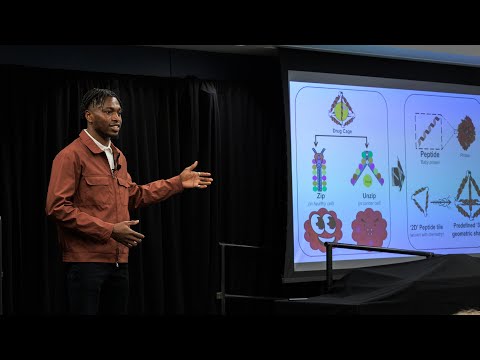
This research develops DNA-origami-enhanced nanopores to detect individual biomolecules from a single drop of blood. By slowing molecules and reading their electrical signatures with machine learning, the technology enables rapid, ultra-early disease diagnosis without traditional laboratory testing.
This research explores how rearranging atoms in crystal thin films can radically change material behavior. By engineering strain and atomic orientation in lanthanum strontium manganite films, the work links structure to electrical and magnetic properties, enabling the design of custom materials for next-generation electronics and computing technologies.
This research develops sustainable screen materials using nanoscale “sponges” that trap light-emitting molecules. By converting these materials into ultra-thin nanosheets, the study offers brighter, longer-lasting, and energy-efficient alternatives to toxic, non-renewable screen components, reducing environmental impact while supporting future global screen demand.
This research develops a theoretical framework for understanding electron–hole interactions in quantum dots, focusing on positive and negative trions. By analytically modeling their behavior under electric and magnetic fields, it bridges gaps between theory and experiment, supporting advances in quantum electronics, energy technologies, and targeted medical applications.
This research uses neutron scattering — “neutron vision” — to reveal the full structure of complex nanoparticles that X-rays can’t fully resolve. By developing statistical methods to optimise experiment design and analyse data, the project enables clearer structural insights, accelerating the development of advanced materials for energy, medicine and nanotechnology.
This research uses a scanning tunneling microscope to visualize and measure individual atoms using quantum tunneling. By mapping surfaces atom-by-atom and probing electronic properties, it advances technologies such as nanowires, superconductors, and atomic-scale chips. Understanding materials at the quantum level enables better design of devices that impact energy, computing, and sustainability.
Type 1 diabetes destroys insulin-producing cells, leaving patients dependent on lifelong injections. Islet transplants could provide freedom, but most cells die quickly. This research uses drug-loaded microparticles that protect transplanted islets, boosting survival, insulin production, and diabetes reversal. The approach could cut costs, reduce donor needs, and transform treatment for multiple diseases.
Pagination
- Page 1
- Next page